Many people assume a 3D printed part is ready to use straight from the machine, but printing is often just the first step.
Cleaning, finishing and inspection can all play an important role in improving a part’s appearance, performance and durability, helping transform a printed component into one that’s ready for testing, demonstration or end-use applications.
In this guide, our Technical Support Officer, Steve Knowles, explains what happens after the print and how additive manufacturing post-processing techniques help turn 3D printed parts into finished, application-ready components.
Why post-processing matters
From smoothing surfaces and enhancing appearance to improving durability and how a product feels in the hand, additive manufacturing post-processing is often what transforms a 3D printed part into something that is ready for real-world use.
With so many additive manufacturing materials now available, choosing the right material is only part of the process. The right 3D post-processing technique can make a significant difference to the final result. It can help improve:
- Surface finish
- Mechanical performance
- Appearance and aesthetics
- Biological and chemical resistance
- User experience and feel
From functional prototypes to developing an end-use product, post-processing 3D parts is often the final step that ensures a part looks, feels and performs exactly as intended.
Removing supports and cleaning parts
Before a 3D printed part can be finished, it needs to be cleaned and prepared. This includes removing support structures, excess powder from powder bed processes, or uncured resin from resin-based prints.
Care is needed during support removal, especially on parts with complex geometries or delicate features, to avoid damaging the component. Cleaning is also a critical first step, ensuring the part is ready for any further additive manufacturing finishing processes and helping to achieve the best possible outcome.
FDM-printed (Fused Deposition Modelling) parts often need support structures, but when these are printed in the same material they can be difficult to remove and may leave marks on the surface. Using a multi-material printer allows supports to be printed in a different, incompatible material, so they simply pull away cleanly, leaving a much better finish.
Additional post-processing techniques, such as hand sanding or applying filler before sanding, can further improve surface quality. While these methods can achieve an excellent finish, they are labour-intensive and can add significant time and cost to the manufacturing process.
Bead blasting for a professional finish
We’re often asked to enhance additively manufactured components using bead blasting.
Bead blasting is a 3D printing post-processing technique that uses fine media propelled at the surface of a part to remove residual powder and create a more consistent finish. It is often the next step after cleaning, helping to give parts a cleaner, more professional appearance.
As well as improving surface finish, bead blasting can reduce the visibility of layer lines and enhance the tactile feel of a component, making it look and feel more like a finished product.
This makes it particularly valuable for presentation models, customer-facing parts and demonstration components. It is commonly used on nylon parts produced through powder bed fusion technologies, as well as functional prototypes and low-volume production parts.
Vapour Smoothing (Vapour Fusing)
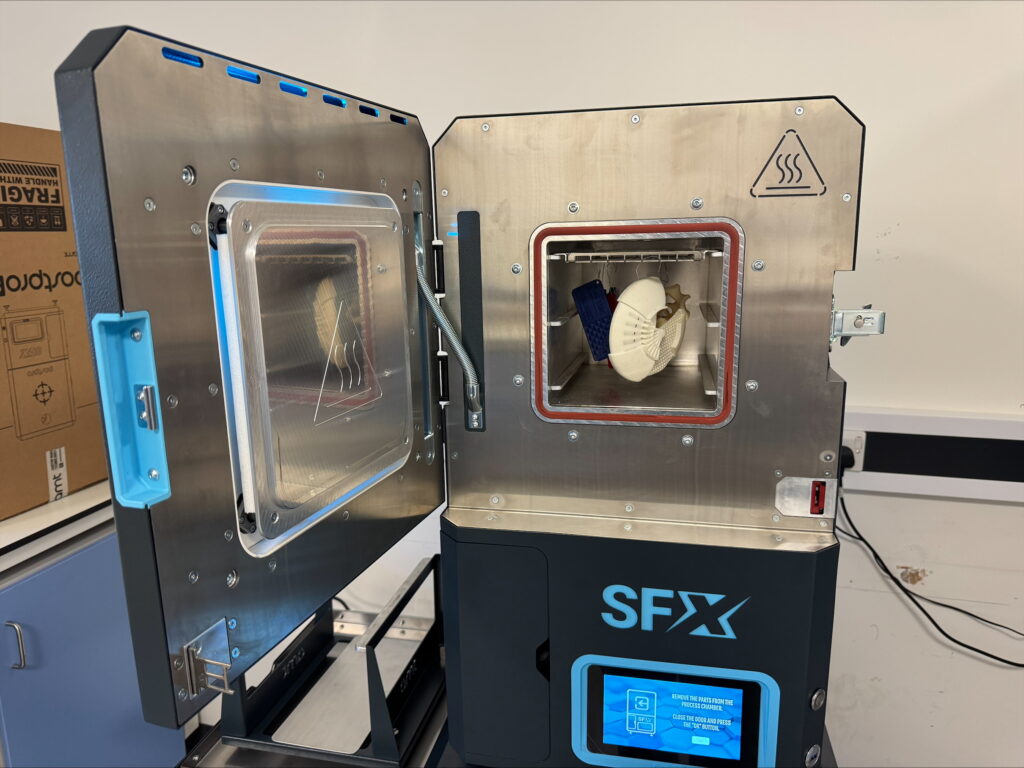
We invested in vapour smoothing technology as an additional tool to our 3D printing post processing capabilities.
Vapour fusing exposes parts to controlled vapours that gently reflow the outer surface giving components a smoother surface finish. It can also help reduce porosity, improve water and chemical resistance, allowing for easier surface cleaning.
These additional durability aspects and enhanced visual appearance, makes it popular with those creating consumer products, medical device housings, low volume production parts, as well as those requiring a high-quality aesthetic finish.
Although this is predominantly used for SLM nylon parts, some FDM materials can be chemically treated to improve their appearance. Materials such as ABS and PVB respond particularly well to vapour smoothing, reducing visible layer lines and creating a smoother, glossier finish.
Colouring, coatings and additional finishing
For many applications, post-processing goes beyond cleaning and surface finishing. Additional finishing techniques can help 3D printed parts look, feel and perform more like conventionally manufactured products.
Options include dyeing nylon parts to achieve a consistent colour, applying paint or surface coatings to improve appearance, and adding protective coatings to enhance durability in demanding environments. Cosmetic finishes and branding elements can also be incorporated to create a polished, customer-ready product.
These finishing processes are particularly useful for presentation models, demonstration components and end-use parts, helping to improve both aesthetics and performance while ensuring components are fit for their intended application.
Inspection and quality assurance
Post-processing 3D printed parts isn’t just about making parts look better. It’s also a chance to check that they’re built correctly and ready for use.
This can include checking dimensions, assessing surface quality and, for more complex parts, using X-ray CT scanning to look inside components without damaging them. It’s an effective way to identify issues such as voids, cracks or trapped powder before a part reaches its final application.
We can help match businesses with the right surface finishing for 3D printing and validation processes to maximise the value of their printed components.
Get in touch to find out more. [link to technology@ email?]